
What to Expect at Your First Singapore Omakase: A 2026 Guide

How Top Asia Select approaches food content
Our food and beverage guides are written to be genuinely useful for Singapore residents and visitors — with honest assessments, specific prices, and no paid placements. Where businesses are featured editorially, this is disclosed.
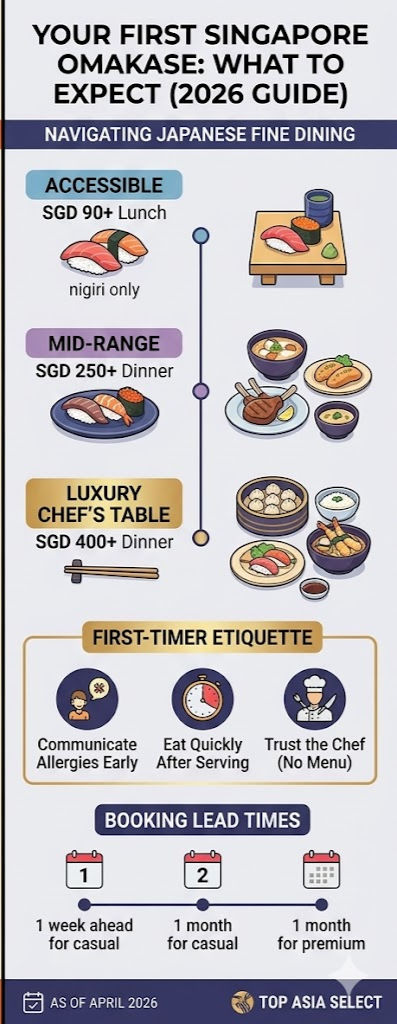
Omakase in Singapore — the fastest-growing dining category in 2026
Omakase — the Japanese term meaning "I leave it to you" — has exploded in Singapore's dining scene. In 2026, Singapore has more omakase restaurants per capita than almost any city outside Japan, spanning a price range from accessible SGD 90 lunch counters to SGD 400+ per person chef's table experiences.
For someone who has never done it, the format can seem intimidating. You are handing control of the entire meal to the chef, you do not know in advance what you will eat or how many courses will arrive, and the etiquette is real. This guide demystifies the entire experience so your first omakase is a pleasure rather than an anxious guessing game.
What omakase actually means
Omakase literally translates to "I leave it up to you" and in a dining context means that the chef selects every dish based on what is at shun — seasonal peak quality — that day, what best represents the restaurant's style, and what sequence of flavours creates the best overall experience.
You do not order from a menu. You arrive, sit at the counter (in most cases), and the meal unfolds course by course. The chef controls pace, portion, flavour progression, and presentation. Your role is to eat, engage, and enjoy.
At a good omakase restaurant in Singapore, this format produces a genuinely different eating experience from any a la carte meal — the chef is cooking for you specifically, responding to your reactions, and has complete creative freedom to show you what they do best.
Omakase price tiers in Singapore 2026
Tier | Price per person | What to expect | Example format |
Accessible | SGD 90–130 | Lunch counter format. 8–12 courses. Quality ingredients but not premium cuts. A genuine introduction to the format at a manageable price point. | Sushi omakase lunch: 3 appetisers, 8–10 nigiri, miso soup, tamago |
Mid-range | SGD 130–220 | Dinner service. 10–15 courses. Better ingredient access — seasonal fish, premium cuts. More formal pacing. | Japanese kaiseki: seasonal soup, sashimi, grilled course, rice course, dessert |
Premium | SGD 220–350 | Full dinner counter. 15–20 courses. Chef's best seasonal ingredients. Extended service, sake pairing available. | Full sushi omakase: multiple appetisers, premium nigiri selections, hand rolls, dessert |
Luxury | SGD 350–600+ | Chef's table format. Premium imported ingredients — otoro, uni, wagyu. Extended service 2.5–3 hours. | Multi-course omakase with wine or sake pairing throughout |
All prices above are before the standard 10% service charge and prevailing 9% GST. On a SGD 150 omakase, that adds approximately SGD 28 to the final bill — factor this into your budget before booking.
Deposit and no-show policy: most Singapore omakase restaurants in 2026 require a credit card deposit at the time of booking — typically SGD 50–150 per person. No-show fees are strictly enforced and non-refundable within 24–48 hours of the reservation. Read the cancellation policy before confirming.
What to wear
Singapore omakase dress codes are more relaxed than equivalent restaurants in Japan or New York. That said, counter dining means you are in full view of the chef and other diners throughout the meal.
• Accessible tier: smart casual — neat jeans and a collar are fine
• Mid-range: smart casual to smart — no shorts, no flip flops
• Premium and above: smart — a clean shirt or dress, no sportswear
• Strong perfumes or colognes are genuinely disruptive at an omakase counter — avoid or use minimally. You are sitting inches from the chef and other diners for 1.5–2.5 hours.
How to communicate dietary needs
Most Singapore omakase restaurants ask about dietary restrictions and allergies at the time of booking — not on arrival. Be specific and honest when booking:
• Shellfish allergy — very important to declare as many sauces and broths contain shellfish even when not listed as a main ingredient
• No raw fish — chefs can usually substitute cooked preparations but this significantly changes the experience at a sushi omakase
• Vegetarian or vegan — possible at some restaurants but must be declared in advance; most omakase menus are protein-heavy by nature
• Halal — very few omakase restaurants in Singapore are halal-certified; verify before booking
• Pregnancy restrictions (no raw fish, no certain fish types) — always declare; chefs accommodate this regularly
Be honest about restrictions when booking — not when you sit down. Declaring a severe allergy on arrival forces the chef to rethink the entire service mid-course. It is genuinely disruptive and risks your safety if the kitchen is not prepared. Always declare at booking, in writing if possible.
Booking lead times in Singapore 2026
Tier | Typical booking lead time | Notes |
Accessible lunch omakase | 1–2 weeks ahead | Some counters take walk-ins at lunch if there are cancellations — worth calling same-day |
Mid-range dinner | 2–4 weeks ahead | Weekends book faster than weekdays |
Premium counter | 4–8 weeks ahead | Some popular counters have waiting lists — ask to be added even if your preferred date is full |
Luxury / chef's table | 2–4 months ahead | For marquee restaurants book as far in advance as possible |
Booking tip: when you receive the booking confirmation, screenshot or save the cancellation policy. Most 2026 Singapore omakase counters charge the full deposit (SGD 50–150/person) for cancellations within 24 hours. Some charge the full menu price for same-day no-shows.
What happens during service — the etiquette
• Arrive on time — omakase services are timed precisely. Late arrival means missed courses or a compressed experience for you and disruption for the counter.
• Eat nigiri promptly — when the chef places a piece of nigiri in front of you, eat it within 10–15 seconds. The rice is served at body temperature and seasoned precisely; waiting too long changes the flavour profile as the rice cools and the fish warms. This is not a rushed experience — it is a calibrated one.
• Do not dip at high-end counters — at premium and luxury omakase restaurants, the chef brushes each piece of nigiri with nikiri (a sweetened, reduced soy sauce) before serving. Dipping the nigiri into the side soy sauce bowl overrides the chef's seasoning. Unless the chef specifically suggests the soy bowl, leave it for sashimi only.
• Engage with the chef — counter dining is interactive by design. Ask about the fish, the provenance, the technique. Good chefs enjoy the conversation and it makes the experience significantly better.
• Photography is generally acceptable but ask first — most chefs allow it between courses. Avoid using flash and do not hold up service for a photo.
• Sake pairing — if offered, it is worth considering at least once. A well-chosen sake pairing at a sushi omakase is genuinely instructive and typically adds SGD 60–120 per person.
• Tipping is not standard in Singapore — service charge of 10% is included in the bill. Additional tipping is not expected and most omakase restaurants do not accept it.
Looking for where to eat in Singapore across other formats? See our fine dining guide and our neighbourhood food guides for where to eat near the CBD.


Comments